Home / Articles / WooCommerce AI-Powered Security Scanning: What Changed?
News / Update
WooCommerce AI-Powered Security Scanning: What Changed?
WooCommerce says AI-assisted code scans now flag more potential vulnerabilities before release. Here is what its 2026 findings, new patch schedule, and extension-update policy mean for store owners.
Đoàn Công TuấnPublished 8 Nov 2026Updated 16 Nov 2026
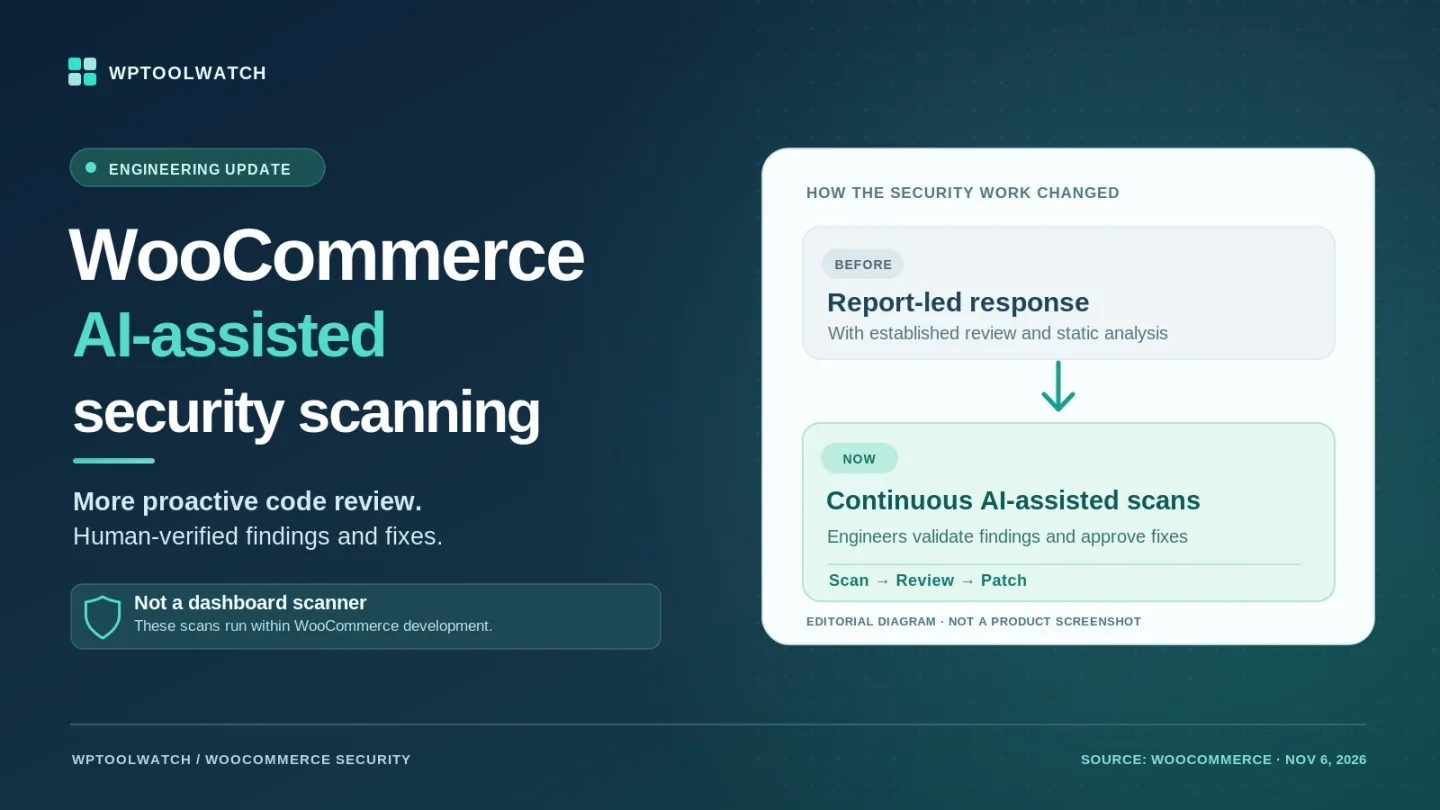
On November 6, 2026, WooCommerceoutlined a shift in its security work: AI-assisted scans now inspect code continuously, help review incoming reports, and feed a more predictable patch process. This is not a new security-scan button for store owners. It is work inside WooCommerce's development and vulnerability-response pipeline.
The useful question for merchants isn't how many warnings AI can produce. It's whether confirmed problems are fixed, shipped, and installed on the stores that need protection.
What Changed in WooCommerce Security Scanning?
WooCommerce says it began expanding proactive security research in late May 2026. Previously, much of its vulnerability work followed external reports alongside existing code review and static-analysis tools. Now AI models scan each merge into WooCommerce core's trunk and release branches; merges to trunk also receive an AI-assisted regression review.
The scans cover code the project maintains, not a merchant's live WordPress installation. They can flag possible defects before release, but they cannot certify that a deployed store, its third-party plugins, or its hosting is secure.
What WooCommerce’s AI Scans Have Found
The November engineering report gives several different measurements. They should not be combined into one success rate:
In July, a retrospective scan of a year's releases rediscovered all previously known high-severity issues in that evaluation set. In August, deeper scans of the monorepo and maintained extensions produced about 700 potential findings—not 700 confirmed vulnerabilities.
Since August, automated merge scans have surfaced 34 security-related issues, 18 validated as real. A separate AI regression-review process was reporting roughly 77% valid findings. Those figures describe different workflows.
WooCommerce also joined Anthropic's OSS Scanner program in October. Its initial enrolled projects received about 200 findings in total; WooCommerce says roughly 90% of findings within the platform software subset were valid after triage. That percentage does not apply to all 200 findings. These are WooCommerce's reported results, not independently audited measurements or counts of exploited stores.
AI Flags Problems; Engineers Still Approve Fixes
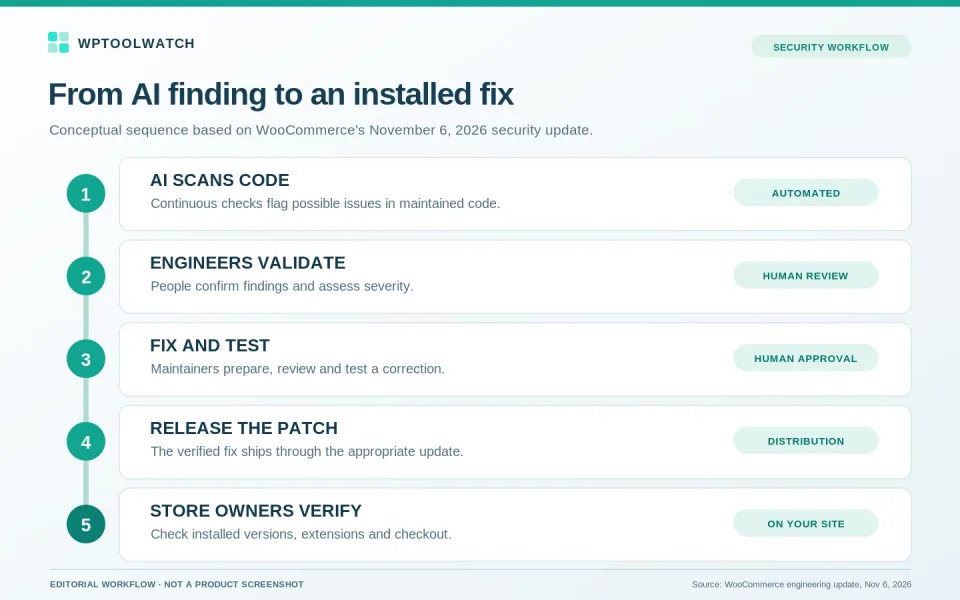
Automattic's internal SentrySift tool gives incoming vulnerability reports an AI first-pass assessment. Engineers still confirm whether a finding is genuine, assess its severity, test the proposed correction, and approve what ships. That distinction matters: scanning can expand coverage without turning every model-generated warning into a security advisory.
Conceptual editorial workflow based on WooCommerce’s November 6, 2026 engineering update; not a screenshot or a guarantee of security.
I see continuous scanning as a better use of AI than publishing impressive raw alert counts. The harder measure is how reliably the team verifies and resolves the findings.
Security Patches Now Have a Different Release Cadence
WooCommerce's new default is to ship Critical and High severity fixes in the next patch release of the current version, while Medium and Low fixes generally arrive in the patch release after the next minor version. Exceptions remain possible; this is a scheduling policy, not a promise that every case follows an identical calendar.
WooCommerce 11.2.2, issued November 4, is the first security release under the approach, including Store API, checkout, and admin hardening. Its release notes also list a database update, so verify that it completes and check checkout after upgrading. The November 6 announcement identifies 11.3.1 as a planned follow-up, not an already-shipped update. Older release lines also have limits: WooCommerce's backport policy generally reserves broad support for the most severe issues (CVSS 9 or above) within its rolling window.
What Store Owners and Developers Should Check
Starting with WooCommerce 11.2, WooCommerce.com can flag some Marketplace extension security updates as required. Eligible stores—connected to WooCommerce.com, with an active subscription for the extension—may receive these fixes on the next update check even if the dashboard auto-update toggle is off. This does not cover every plugin or store, and programmatic update blocking can still prevent installation.
My priority list is practical: verify installed versions of WordPress, WooCommerce, and extensions; back up and test relevant checkout flows after security patches; and check every publicly accessible staging site as well as production. Do not assume an automatic update ran successfully.
Check PHP under Tools → Site Health → Info → Server and ask your host about security fixes. WooCommerce recommends PHP 8.3 or newer where compatible. Its announced plan is for WooCommerce 11.6, expected February 2027, to require at least PHP 8.1; meeting that future compatibility minimum is not the same as receiving current PHP upstream security support. Extension developers should also scan their own code and handle findings before release.
Does More Security Scanning Mean WooCommerce Is Less Secure?
Not by itself. More scanning can uncover more existing problems, and a scanner finding is neither proof of exploitation nor proof of a breach. WooCommerce reports that its own scans and opted-in programs have found more than twice as many valid core issues as external reports during this effort, but that alone does not establish a measurable reduction in risk for every merchant.
The stronger signal is the combination of earlier discovery, human verification, separate patch releases, and dependable delivery. Keep judging WooCommerce by the fixes that reach your site—not simply by how sophisticated its AI tools sound.