Paid WordPress caching and front-end optimization plugin that favors quick setup. Useful when one workflow replaces scattered tools, but the gain depends on your hosting, dynamic content and existing stack.
I would pay for WP Rocket when it replaces a messy optimization setup and saves enough maintenance time to justify renewal. I would not buy it to chase a vendor PageSpeed promise. Check what your host already handles, then compare the same URLs and user flows before and after. For WooCommerce, a correct price and working checkout matter more than a prettier lab score. This judgment is based on documented behavior and licensing, not a hands-on speed test.
Why this rating?
WP Rocket offers a coherent cache and front-end optimization workflow with detailed troubleshooting guidance. It is strongest when it replaces overlapping tools; recurring costs, host-cache overlap and exclusions for interactive pages reduce its value when those needs are already covered.
Research & assessment details
Documentation-based assessment by WPToolWatch Editorial. No hands-on benchmark.
It is not a substitute for reliable hosting, lean third-party scripts or careful measurement.
WP Rocket sells convenience: a single paid WordPress plugin for page caching, cache preload and front-end delivery controls.
The strongest case is a site where setting up and maintaining separate caching, asset and media tools takes more effort than the license costs. It is not a substitute for reliable hosting, lean third-party scripts or careful measurement. A better performance grade is possible, not guaranteed.
Automatic caching versus optional optimization
If a license expires, local features largely continue, while updates, support and cloud services stop.
On compatible hosts, page and mobile caching are automatic; cache preload and CSS/JavaScript minification are enabled by default.
Delay JavaScript, Remove Unused CSS and many media adjustments are separate choices, not safe one-click fixes for every site.
Delay JavaScript, Remove Unused CSS and many media adjustments are separate choices, not safe one-click fixes for every site.
Used CSS generation runs through the vendor cloud and needs an active license, a publicly reachable page and working background jobs. Test visible layout, menus, forms and consent scripts after enabling aggressive settings.
Where the hosting stack changes the value
WP Rocket also does not provide Redis/object caching; that is a separate host-side or plugin decision, particularly important for uncached, dynamic pages.
WP Engine and Kinsta manage their own page cache, so WP Rocket disables its own page-cache layer there while leaving other optimizations available. If your host already provides caching and a CDN, compare what remains rather than paying twice for similar functions.
WP Rocket also does not provide Redis/object caching; that is a separate host-side or plugin decision, particularly important for uncached, dynamic pages.
WooCommerce: defaults are helpful, but not enough
WP Rocket automatically excludes standard WooCommerce Cart, Checkout and Account pages.
Before launch, test product prices, cart totals, currency, coupons and checkout for guest and signed-in visitors, including mobile and different locations.
It cannot rewrite how a third-party plugin renders a location-based price, wishlist, cookie-dependent fragment or custom cart widget. WooCommerce geolocation query strings also limit preload. Before launch, test product prices, cart totals, currency, coupons and checkout for guest and signed-in visitors, including mobile and different locations.
License terms, trial and CDN costs
Single, Plus and Multi primarily differ by licensed website count.
If a license expires, local features largely continue, while updates, support and cloud services stop.
WP Rocket advertises a one-year option and a three-year initial term paid upfront; promotions and currency may change the checkout total, and a three-year term renews annually at the applicable rate afterward.
A 14-day trial is documented but requires a payment method. If a license expires, local features largely continue, while updates, support and cloud services stop. RocketCDN Free covers up to three pages, not a full-site CDN; the broader tier is separate.
A practical buying test
Delay JavaScript, Remove Unused CSS and many media adjustments are separate choices, not safe one-click fixes for every site.
Start with your current mobile and desktop results, then record behavior on real pages—not only the homepage.
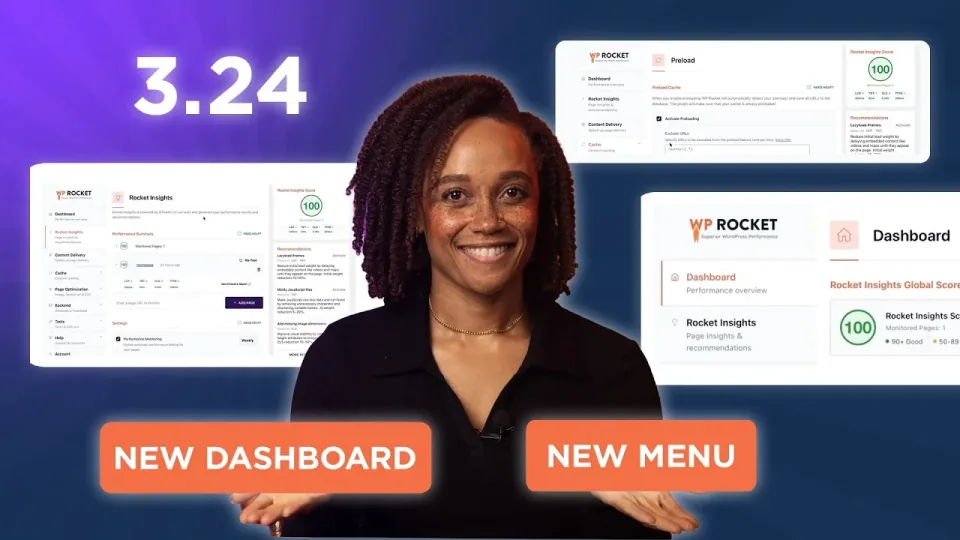
Use staging to compare the same URLs and test menus, form submissions, analytics, logged-in behavior and checkout before changing production settings. The official changelog lists WP Rocket 3.24 on October 27, 2026, but a release note does not establish compatibility with your particular theme or extensions. If the measured benefit is small and your existing stack is stable, keep the simpler setup.
Licensed site allowance: 1 website(s) for this tier; initial one- or three-year term may be offered at checkout. Plugin can keep working with reduced capabilities after license expiry; no lifetime updates.
Single, Plus, Multi — 50 sites · Renewal
Auto-renews unless cancelled; a current one-year subscription includes updates, support and cloud access. Verify the amount shown for renewal in your account or checkout.
Plus · License & support
Licensed site allowance: 3 website(s) for this tier; initial one- or three-year term may be offered at checkout. Plugin can keep working with reduced capabilities after license expiry; no lifetime updates.
Multi — 50 sites · License & support
Licensed site allowance: 50 website(s) for this tier; initial one- or three-year term may be offered at checkout. Plugin can keep working with reduced capabilities after license expiry; no lifetime updates.
REFERENCE PRICES, NOT CHECKOUT QUOTES: the vendor snapshot reviewed on 2026-11-08 listed annual Single $59 (1 website), Plus $119 (3) and Multi $299 (50); those exact figures and their 2026-11-08 checkedAt values remain in structured plans. On 2026-11-09 the vendor pricing page appeared in newer indexed versions with monthly-equivalent promotional pricing, a one-year choice and a three-year term prepaid in full; snapshots differed in discounts and offer dates. These reference annual amounts are not current checkout quotes; initial and renewal totals, tax and customer currency can vary. The three-year contract renews annually after the initial term under official sales terms. A payment-method-backed 14-day trial is documented by the newer vendor FAQ, though older pages still deny it. For qualifying direct non-trial purchases the vendor advertises a 14-day money-back guarantee; the first charge following a free trial is excluded from that guarantee. Single, Plus and Multi differ by website allowance, not a basic-versus-premium feature split; larger Multi 100/500-site prices are not stored without confirmed checkout totals. A license that expires loses updates, vendor support and cloud-backed features, although most local functions continue. RocketCDN Free covers up to 3 pages; RocketCDN Pro and image-optimization or object-cache services are separate.
Updates, support, dynamic-exclusion updates and selected cloud features require an active license
License model
Paid WP Rocket Single/Plus/Multi licenses; 1-year or prepaid 3-year initial term depending on checkout; continued updates and cloud services require an active license
Support channel
Vendor support and knowledge base available with active license (and during an eligible trial)
A useful default configuration: page caching on compatible hosts, preload and basic minification without a long setup checklist
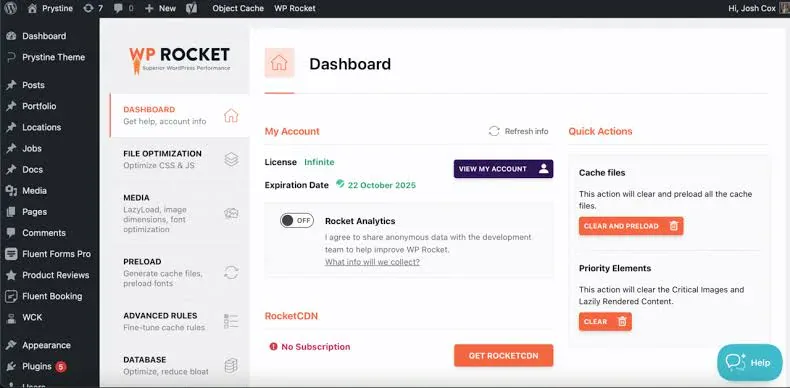
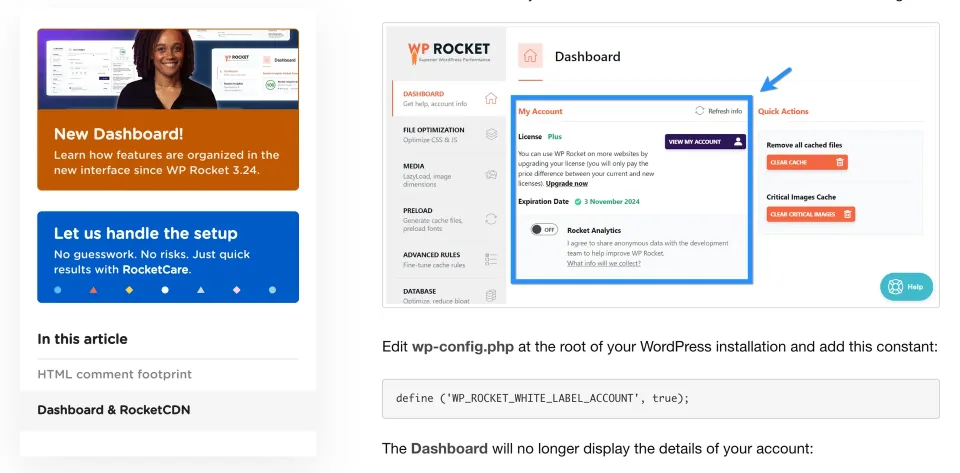
One interface for CSS/JS delivery, lazy-loading options, cache management and Rocket Insights
WooCommerce awareness and thorough documentation for managed hosts and troubleshooting
License tiers accommodate one site through larger client portfolios without dividing core features
What to consider
Recurring license cost; updates, support and cloud-backed features depend on an active term
WP Rocket does not supply object caching, and a full-site RocketCDN service may cost extra
Managed hosting may disable its own page cache, narrowing the extra value
Delay JS, unused-CSS removal and personalized content can require exclusions and careful regression checks
Best for
Owners of small-to-medium WordPress sites and stores on hosting that does not already cover the same optimization stack; freelancers and agencies who prefer one documented workflow to coordinating several tools, and who can test changes before rollout.
Consider alternatives if
A free-only budget; sites already well served by host cache plus existing front-end tools; or highly personalized stores and membership projects without time to test exclusions, cookies and checkout behavior.
BEFORE YOU DECIDE
Frequently asked questions
Does WP Rocket have a free version or free trial?
There is no permanent free plugin edition. Newer official FAQ and support documentation describe a 14-day trial requiring a payment method; if you do not cancel, it converts to a paid license. Older vendor pages still say there is no trial, so confirm the exact offer at checkout.
How much does WP Rocket cost for one or several sites?
A vendor pricing snapshot checked November 8, 2026 showed Single at $59/year for one website, Plus at $119/year for three and Multi at $299/year for 50. More recent indexed pricing shows promotions, monthly-equivalent displays and a three-year prepaid option; do not rely on the stored amounts as today’s checkout price. Confirm first-term cost, taxes and renewal rate with the vendor.
Which features work without additional setup?
WP Rocket documents automatic page/mobile caching on compatible hosts, with cache preload and CSS/JavaScript minification on by default. Delay JS, Remove Unused CSS and many other options are separate controls. Avoid enabling everything at once on a live site.
Why might Remove Unused CSS fail on my staging site?
Used CSS is generated by an external service that needs a valid license and access to a public page. Password protection, firewalls, broken cron and local environments can block generation. Test the feature on a reachable staging or production-like setup and check the vendor troubleshooting steps.
Will WP Rocket replace Kinsta or WP Engine caching?
No. On those managed hosts WP Rocket disables its own page cache to avoid conflict; front-end file and media optimizations remain available. Ask the host what it already provides and measure whether the extra controls justify a second subscription.
Is WP Rocket safe for WooCommerce checkout and country-based pricing?
Standard Cart, Checkout and Account pages are automatically excluded from page cache, but a custom PHP-rendered widget or location-specific price may still serve stale or wrong content if its developer did not make it cache-compatible. WooCommerce geolocation query strings cannot be preloaded. Test currencies, coupons, cart states and both guest and signed-in checkout.
Can WP Rocket guarantee better Core Web Vitals?
No. It can reduce delivery overhead, but hosting latency, layout shifts, third-party tags and page-specific code are outside any blanket guarantee. Compare the same URLs and user flows before and after, and distinguish lab scores from real-user data.
Does WP Rocket include Redis/object caching?
No. WP Rocket provides page and front-end caching controls, not a Redis object-cache engine. Object caching requires host support and another configuration/plugin, and it can be especially useful on uncached checkout or membership pages.
Is full-site RocketCDN included with the license?
No. RocketCDN Free can accelerate assets for up to three pages with 10 edge locations. A wider full-site RocketCDN Pro subscription is a separate purchase; it is also tied to the production domain, not automatically reusable for staging.
What happens if I stop renewing WP Rocket?
The installed plugin continues many local functions, but support, new plugin updates, updated dynamic exclusions and license-dependent cloud features end. WP Rocket’s help center describes a short 15-day cloud-feature grace period. Renewing is therefore more than a support decision if you use Used CSS or Rocket Insights.
What is the difference between trial cancellation and a refund?
A documented 14-day trial can be cancelled before it converts to a paid subscription. The vendor’s updated refund policy reserves its 14-day money-back guarantee for qualifying purchases made without a free trial; the first post-trial charge is excluded. Read the terms shown with your checkout rather than assuming trial plus another 14-day refund window.
Does a prepaid three-year term renew every three years?
No. The vendor sales terms say the initial three-year price is paid upfront and the subscription then renews annually at the applicable one-year rate unless cancelled. Confirm the renewal notice and total before purchasing.
Alternatives & comparisons
Explore other published WordPress products, with matching categories listed first.
Free WordPress optimization plugin with server-level page caching on LiteSpeed-powered infrastructure or QUIC.cloud. Check hosting requirements, WooCommerce safety and service costs.
WPBakery is a shortcode-based WordPress content builder with frontend and backend editors. A practical choice for existing WPBakery sites; new block-first projects should weigh migration costs.